Wednesday, January 27, 2010

Five Reasons to Wait on the iPad

Like most geeks, I watched with great anticipation as the iPad was unveiled yesterday. In my case, it was from liveblogs monitored on spotty 3G and WiFi access at the Jfokus after-conference event. I'm reasonably impressed with the device, especially the $500 price point on the low end. But after giving it some thought, I have a few good reasons to wait on purchasing one. Here's five I came up with:
  1. Wait for the next generation. Never, ever buy the first generation of a device this new and this complex. Doubly so for anything the Apple hype machine is pimping. First-gen devices are always at least a little bit tweaky, and Apple has proven repeatedly that their first-gen devices are overpriced, underpowered, and replaced by something better in 4-6 months.
  2. Wait for competitors to answer. Sure, there have been other tablets and "slates" announced over the past year, but the iPad has moved the bar. Given the number of competing vendors, the availability of viable tablet options like Windows 7 and Android (or Chrome OS), and the ever-present iControl and iLock-in associated with all things Apple, you can bet there's going to be a bunch of competitive options during 2010.
  3. Wait for everyone else to buy it. Yeah, this one is painful, but think about all the suckers that bought the iPhone right when it came out. You'll spend a couple months as a temporary luddite, ridiculed by your peers. And then you'll get a better device for cheaper and have the last laugh. I mean, isn't half the joy of the iPad in having the bigger iPenis? You can hold off for a while.
  4. Wait for crackers to bust it wide open. Nobody's happy that the iPhone is a closed platform, nor are they happy that the App Store is so sketchy at approving applications. So why not wait and see what the busy iPhone hackers can do with an iPad before diving it? Chances are it will be a far better laptop replacement once they get ahold of it.
  5. Wait because you don't actually need it. It can't replace your phone. It can't replace your laptop. It can't replace your 50" LCD TV. Seriously now...what do you need it for?
Me, I'm on the fence. I can afford it, but then I probably wouldn't be able to afford something else. And I'm a programmer...I want to be able to put my own apps on the device (or give apps to friends) without dealing with the App Store gatekeeper. In my ideal world, it would be Apple's hardware and design sensibility combined with Android's open platform and familiar runtime. Anything even close to that would outshine the iPad for me.

Update: One last bit of anecdotal evidence. Before the iPhone, I had held off buying anything other than the crappiest, cheapest phones, the lowest-end music devices (yep, I had the "pack of gum" Shuffle), the most basic digital cameras, and no PDA. I was waiting for something that would allow me to get rid of all devices at once. iPhone obviously did that, as a music/media player, internet device, PDA, phone, and camera all in one. iPad takes two of those features away (phone and camera) and only adds a larger screen with the potential for large-form apps.

Friday, January 8, 2010

Busy Week: JRuby with Android, Maven, Rake, C exts, and More!

(How long has it been since I last blogged? Answer: a long time. I'll try to blog more frequently now that the (TOTALLY INSANE) fall conference season is over. Remind me to never have three conferences in a month ever again.)

Hello friends! It's been a busy week! I thought I'd show some of what's happening with JRuby, so you know we're still here plugging away.

Android Update

Earlier this week I helped Jan Berkel get the Ruboto IRB application working on a more recent JRuby build. There were a few minor tweaks needed, and Jan was interested in helping out, so I made the tweaks and added him as a committer.

The Ruboto IRB project repository is here: http://github.com/headius/ruboto-irb

Lately my interest in JRuby on Android has increased. I realized very recently that JRuby is just about the only mainstream JVM languge that can create *new* code while running on the device, which opens up a whole host of possibilities. It is not possible to implement an interactive shell in Groovy or Scala or Clojure, for example, since they all must first compile code to JVM bytecode, and JVM bytecode can't run on the Dalvik VM directly.

As I played with Ruboto IRB this week, I discovered something even more exciting: almost all the bugs that prevented JRuby from working well in early Android releases have been solved! Specifically, the inability to reflect any android.* classes seems to be fixed in both Android 1.6 and Android 2.0.x. Why is this so cool? It's cool because with Ruboto IRB you can interactively play with almost any Android API:


This example accesses the Activity (the IRB class in Ruboto IRB), constructs a new WebView, loads some HTML into it, and (not shown) replaces the content WebView. Interactively. On the device. Awesome.


I am trusting you to not go mad with power, and to use Ruboto only for good.

RubyGems/Maven Integration

JRuby has always been a Ruby implementation first, and as a result we've often neglected Java platform integration. But with Ruby 1.8.7 compatibility very solid and Ruby 1.9 work under way, we've started to turn our attentions toward Java again.

One of the key areas for language integration is tool support. And for Java developers, tool support invariably involves Maven.

About a year ago, I started a little project to turn Maven artifacts into RubyGems. The mapping was straightforward: both have dependencies, a name, a description, a unique identifier, version numbers, and a standard file format for describing a given package. The maven_gem project was my proof-of-concept that it's possible to merge the two worlds.

The maven_gem repository is here: http://github.com/jruby/maven_gem

The project sat mostly dormant until I circled back to it this fall. But once I got the guys from Sonatype involved (purveyors of the Nexus Maven server) things really got interesting.

Thanks to Tamas Cservenak from Sonatype, we now have something once thought impossible: full RubyGems integration of all the Maven artifacts in the world!

The Nexus RubyGems support repository is here: http://github.com/cstamas/nexus-ruby-support/

~/projects/jruby ➔ gem install com.lowagie.itext-rtf
Successfully installed bouncycastle.bcmail-jdk14-138-java
Successfully installed bouncycastle.bcprov-jdk14-138-java
Successfully installed bouncycastle.bctsp-jdk14-138-java
Successfully installed com.lowagie.itext-rtf-2.1.7-java
4 gems installed
Installing ri documentation for bouncycastle.bcmail-jdk14-138-java...
Installing ri documentation for bouncycastle.bcprov-jdk14-138-java...
Installing ri documentation for bouncycastle.bctsp-jdk14-138-java...
Installing ri documentation for com.lowagie.itext-rtf-2.1.7-java...
Installing RDoc documentation for bouncycastle.bcmail-jdk14-138-java...
Installing RDoc documentation for bouncycastle.bcprov-jdk14-138-java...
Installing RDoc documentation for bouncycastle.bctsp-jdk14-138-java...
Installing RDoc documentation for com.lowagie.itext-rtf-2.1.7-java...


Here's a an example of a full session, where I additionally install Rhino and then use it from IRB: http://gist.github.com/271764

I should reiterate what this means for JRuby users: as of JRuby 1.5, you'll be able to install or use in dependencies any Java library ever published to the public Maven repository. In short, you now have an additional 60000-some libraries at your fingertips. Awesome, no?

There are some remaining issues to work through, like the fact that RubyGems itself chokes on that many gems when generating indexes, but there's a test server up and working. We'll get all the issues resolved by the time we release JRuby 1.5 RC1. Jump on the JRuby mailing list if you're like to discuss this new capability.

Rake? Ant? Why not Both?

Another item on the integration front is Tom Enebo's work on providing seamless two-way integration of Rake (Ruby's build tool) and Ant. There's three aspects to Rake/Ant integration:
  • Using Rake tasks from Ant and Ant tasks from Rake
  • Calling Rake targets from Ant and Ant targets from Rake
  • Mixed build systems with part in Rake and part in Ant
Tom's work so far has focused on the first bullet, but the other two will come along as well. You'll be able to translate your Ant script to Rake and have it work without modification, call out to Rake from Ant, include a Rakefile in Ant and use its targets, and so on.

Here's an example of pulling in a build.xml file, depending on its targets, and calling Ant tasks from Rake:
require 'ant'

ant.load 'build.xml' # defines tasks :mkdir + :setup in ant!

task :compile => [:mkdir, :setup] do
ant.javac(:srcdir => src_dir, :destdir => "./build/classes") do
classpath :refid => "project.class.path"
end
end

Ideally we'll cover all possible integration scenarios, and finally blur the lines between Rake and Ant. And we'll be able to move JRuby's build into Rake, which will make all of us very happy. Look forward to this in JRuby 1.5 as well.

The C Extension Question

One aspect of Ruby itself that we've punted on is support for Ruby's C extension API. We haven't done that to spite C extension users or developers--far from it...we'd love to flip a switch and have C extensions magically work. The problem is that Ruby's C API provides too-invasive access to the internals of objects, and there's just no way we can support that sort of access without incurring a massive overhead (because we'd have to copy stuff back and forth for every operation).

But there's another possibility we've started to explore: supporting only a "safe" subset of the Ruby C API, and providing a few additional functions to replace the "unsafe" invasive bits. To that end, we (as in Wayne Meissner, creator of the FFI implementations for JRuby and Ruby) have cleaned up and published a C extension API shim library to Github.

The JRuby C extension shim library repository is here: http://github.com/wmeissner/jruby-cext

Last night I spent some time getting this building and working on OS X, and to my surprise I was able to get a (very) trivial C extension to work!

Here's the part in C. Note that this is identical to what you'd write if you were implementing the extension for Ruby:
#include <stdio.h>
#include <ruby.h>

VALUE HelloModule = Qnil;
VALUE HelloClass = Qnil;

VALUE say_hello(VALUE self, VALUE hello);
VALUE get_hello(VALUE self);

void
Init_defineclass()
{
HelloClass = rb_define_class("Hello", rb_cObject);
rb_define_method(HelloClass, "get_hello", get_hello, 0);
rb_define_method(HelloClass, "say_hello", say_hello, 1);
}

VALUE
say_hello(VALUE self, VALUE hello)
{
return Qnil;
}
VALUE
get_hello(VALUE self)
{
return rb_str_new2("Hello, World");
}

Here's the little snippit of Ruby code that loads and calls it. Note that the ModuleLoader logic would be hidden behind require/load in a final version of the C extension support.
require 'java'

m = org.jruby.cext.ModuleLoader.new
m.load(self, "defineclass")

h = Hello.new
puts "Hello.new returned #{h.inspect}"
puts "h.get_hello returns #{h.get_hello}"

Among the C API pieces we probably won't ever support are things like RSTRING, RARRAY, RHASH that give direct access to string, array, and hash internals, anything dealing with Ruby's threads or runtime, and so on. Basically the pieces that don't fit well into JNI (the Java VM C API) would not be supported.

It's also worth mentioning that this is really a user-driven venture. If you are interested in a C extension API for JRuby, then you'll need to help us get there. Not only are we plenty busy with Java and Ruby support, we are also not extension authors ourselves. Have a look at the repository, hop on the JRuby dev list, and we'll start collaborating.

JRuby in 2010

There's a lot more coming for JRuby in 2010. We're going to finally let you create "real" Java classes from Ruby code that you can compile against, serialize, annotate, and specify in configuration files. We're going to offer JRuby development support to help prioritize and accelerate bug fixes for commercial users that really need them. We're going to have a beautiful, simple deployment option in Engine Yard Cloud, with fire-and-forget for your JRuby-based applications (including any non-Ruby libraries and code you might use like Java, Scala or Clojure). And we're going to finally publish a JRuby book, with all the walkthroughs, reference material, and troubleshooting tips you'll need to adopt JRuby today.

It's going to be a great year...and a lot of fun.

Saturday, October 31, 2009

Missed RubyConf? Attend Qcon's Ruby Track!

This year, RubyConf reportedly reduced their attendee cap to 250 people (Update: actually 450 people), after hosting a 500 to 600-person conference last year. As you can imagine, this meant a lot of people that wanted to attend were not able to get tickets. To complicate matters, the RubyConf registration site happened to go live during the middle of the night EU time, and by the time most Europeans woke up it was already sold out. What's a Rubyist to do?

Well there's another option. Working with Ryan Slobojan of InfoQ and the organizers of Qcon San Francisco, I'll be hosting a one-day Ruby track the day before RubyConf! Qcon's main conference runs Wednesday through Friday, with my track on Wednesday, November 18th.

And now the REALLY good news! Because we wanted this to be a fallback for folks that could not attend RubyConf, we realized that the full conference fee was simply too high (ranging from $1500 up). So to make it possible for people to attend just the one day Ruby track, you can register with the code "rubywednesday" to get a drastically reduced $350 one-day conference pass. And to sweeten the deal even more, you can pop over to other tracks and attend the keynotes that day. Yes Virginia, there is a Santa Claus!

Those of you attending RubyConf are also welcome to attend this one-day track as well; most of the presentations won't overlap. Here's the lineup, including a special opening presentation by Yukihiro Matsumoto himself!

10:20 - "The Many Facets of Ruby" track opening by me
Ruby has seen a dramatic growth in popularity over the last few years, and there are now many facets to the Ruby story - multiple implementations, game-changing web frameworks, and large-scale use in enterprise solutions. Join us as we explore many aspects of Ruby in today's world.

10:30 - "Why we love Ruby?" by Yukihiro Matsumoto
Why we love Ruby? I have asked myself this question repeatedly. In this presentation, I will disclose my answer as of 2009. The keyword is QWAN.

11:45 - "Basking in the Limelight" by Paul Pagel
Limelight is Ruby on the desktop. Build applications with multiple windows, or just one window. Take control of the desktop, or play nicely with the desktop. Create fun animated games, or productive business apps. Develop rich internet applications, or unwired apps to make you rich. Publish your apps on the internet, or keep them for you and your friends. Do all this, writing nothing but Ruby code, in Limelight.

13:45 - "You've Got Java in my Ruby" by Thomas Enebo
JRuby is now well-established as a popular alternative implementation of Ruby.But why would you want to use it? How can it help you? This talk will detail some of the more interesting differences and advantages of using JRuby. Expect to get a better understanding of how Java makes a faster and more stable Ruby as well as how you can leverage Java features as an extra set of tools for your project.

15:00 - "Rails 3" by Yehuda Katz
I don't have a full abstract for this, but it's what you might expect...an overview of why Rails 3 is really "growing up" the framework, making it more clearly componentized and easier to adapt to more complicated (dare I say "enterprise") applications in the future. In working with Yehuda I know he's also paid special attention to performance.. Rails 3 is going to be excellent.

16:30 - "Rails in the Large: How Agility Allows Us to Build One of the World's Biggest Rails Apps" by Neal Ford
While others have been debating whether Rails can scale to enterprise levels, we've been demonstrating it. ThoughtWorks is running one of the largest Rails projects in the world, for an Enterprise. This session discusses tactics, techniques, best practices, and other things we've learned from scaling rails development. I discuss infrastructure, testing, messaging, optimization, performance, and the results of lots of lessons learned, including killer rock-scissors-paper tricks to help you avoid babysitting the view tests!


I think it's going to an outstanding track, and I'd probably pay the $350 just to see Matz speak if I knew I wouldn't get another chance for a long time. Limelight looks like an outstanding way to build rich client apps using JRuby, and of course you know I like JRuby. Tom will show some of the latest advancements we've done in JRuby, including the ability to produce "real" Java classes at runtime for integrating with Java frameworks better. Rails 3 I've described above, but you really have to see Yehuda present it himself. And of course everyone would like to know how to scale Rails to the moon...Neal knows his stuff.

Here's the track page: The Many Facets of Ruby

And the full conference schedule for Wednesday.

And finally, the registration page (don't forget to use code "rubywednesday").

I really hope to see you all there, so you can get your Ruby conference fix this fall. Tell your friends and let me know if you have any questions!

Friday, September 11, 2009

Announcing JRubyConf 2009

Good news everybody! We're finally going to have JRubyConf!

After over 3 years of heavy development, dozens of deployments and hundreds of users, it's time for a conference for JRuby users. We've talked about it on the JRuby mailing lists, polled users, and seen other JRubyists do the same. And the chorus slowly grew: you all wanted JRubyConf more and more.

Now, thanks to Engine Yard, who's producing the conference, and to sponsors EdgeCase and ThoughtWorks, we'll host the first ever JRubyConf the day after RubyConf, on Sunday November 22nd. This should allow folks attending RubyConf to also attend JRubyConf and not have to schedule a separate trip.

So here's the details:
What: JRubyConf 2009 (the first ever!)
When: Sunday, November 22nd; the day after RubyConf 2009
Where: Same hotel as RubyConf, the Embassy Suites at San Francisco Airport. You don't even have to switch locations!
Why: Because we love you!
Price: FREE!!!
We've been putting together a wide range of talks and speakers, from the JRuby core team members to real-world users; from the latest on deploying Rails to gaming and desktop development. It's going to be a fast-paced event with something for everyone, and best of all, it's FREE!

Space is limited for the event, and you will have to register separately from RubyConf to secure your seat (but you don't have to go to RubyConf to attend JRubyConf!). Check out www.jrubyconf.com for information, registration, and so on, and be quick about it!

See you at JRubyConf 2009!

Wednesday, August 26, 2009

Introducing Surinx

In June of this year, I spent a few hours formulating a dynamic cousin to Duby. Duby, if you don't remember, is a static-typed language with Ruby's syntax and Java's type system. Duby supports all Ruby's literals, uses local type inference (only argument types *must* be declared), and runs as fast as Java (because it produces nearly identical bytecode). But with the advent of invokedynamic, Duby needed a playmate.

Enter "Juby". Juby is intended to be basically like Duby, in that it uses Java's types and Ruby's syntax. But it takes advantage of the new invokedynamic opcode to be 100% dynamic. Juby is a dynamic Duby, or perhaps a dynamic Java with Ruby syntax. It's not hard to comprehend.

But the name was a problem. Juby sounds like "Jewbie", a pejorative term for a Jewish person. So I sent out a call for names to the Twitterverse, ultimately ending up with far more names than I could choose from.

The name I have chosen, Surinx, has a simple story attached. You see, when James Gosling created Java, he originally named it "Oak", after the tree outside his window. So I followed his lead; the tree (a bush, really) outside my window is a lilac, Syringa vulgaris. The genus "Syringa" is derived from New Latin, based on a Greek word "surinx" meaning "shepherd's pipe" from the use of the Syringa plant's hollow stems to make pipes. Perhaps Surinx is building on the "hollow stem" of the JVM to produce something you can smoke (other dynamic languages) with. Combined with its cousin "Duby", we have quite a pair.

And in other news, the simple Surinx implementation of "fib" below (identical to Ruby) manages to run fib(40) in only 7 seconds on current MLVM (OpenJDK7 + invokedynamic and other tidbits), a five-fold improvement over JRuby's fastest mode (jruby --fast).

def fib(a)
if a < 2
a
else
fib(a - 1) + fib(a - 2)
end
end

Given that JRuby has started to support invokedynamic, the solid performance of Surinx bodes very well for JRuby's future.

Please welcome Surinx to your language repertoire!

Sunday, August 2, 2009

Which Deployment for JRuby on Rails?

We often get the question "which deployment option is the best for JRuby on Rails?" The truth is that it depends on what you need out of deployment.

If you have a fairly straightforward Rails app without a lot of service dependencies and a greenfield deployment target, your best bet is probably the GlassFish gem right now. It performs really well, can handle high loads and high concurrency, and automatically detects Rails' threadsafe mode, scaling better when it's turned on. I'm no longer a Sun employee, and I still think the GF gem is an outstanding piece of work. Here's my howto on GF gem + JRuby on Rails + Apache. Update: Here's information on using Capistrano with the GlassFish gem.

If you have an existing Java EE or web container like Tomcat, JBoss, GlassFish, WebLogic, or WebSphere, you want to look into Warbler. Warbler packages your application as a .war file, suitable for deployment on any of these standard servers. The Warbler wiki is the best place to learn about deploying with Warbler.

If you're looking for something that's somewhat greenfield but also needs more advanced services like scheduled asynchronous jobs, web services, and some level of EE integration, you should look at JBoss's TorqueBox, a customized JBoss specially tailored for deployment of Rack-based apps (like Rails) on JRuby.

If you're looking for a hosting provider that can take your app and make it "just work", then you should look into Engine Yard's JRuby cloud offering. We don't yet have it 100% ready to go, but it won't be long and it will be fantastic. For now you can give us some direction and input on what that hosting/cloud should look like.

All told, there's a lot of great options for JRuby deployment, and no one of them is going to be perfect for everyone. Choose wisely, and join the JRuby mailing lists if you have questions.

Saturday, August 1, 2009

Return of Ruboto!

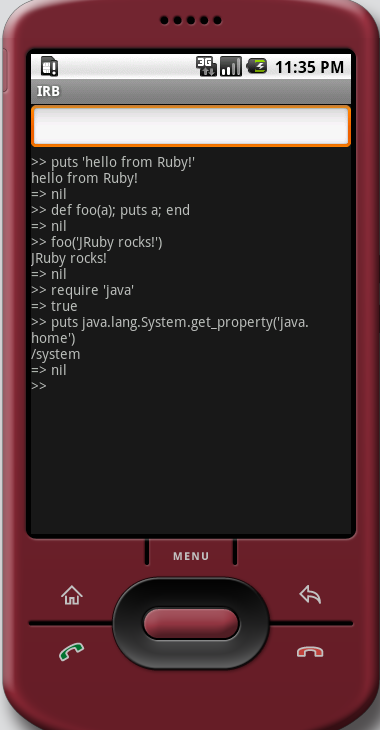
It's been a while since I was able to work on JRuby's Android support, but tonight I managed to finally circle back. And I've got something much more impressive working today: a real IRB application!


(And yes, this works just fine on the phone too)

It turned out to be incredibly easy to get this working. I'm not using any stinking plugin because they all seemed to just get in my way. So I generated a dummy application using the "android" tool, dropped the jruby jar in "libs", wrote up a quick interactive console, built and signed it, and that's all there was to it.

JRuby turns out to work very well for this sort of thing because we have an interpreter, so we can parse and execute code dynamically. Hooray for interpreted support!

I had to tweak a couple things to work around shortcomings in Android:
  • I had to edit the dx tool to allow up to a 1024M heap, since JRuby's jar has a ton of stuff in it
  • I had to catch and swallow an ArrayIndexOutOfBounds exception coming out of Dalvik's enum support. Bug!
This is of course a proof-of-concept. Writing full applications in Ruby isn't far behind, but we'll need a couple adjustments to JRuby to support it well:
  • Ability to run 100% precompiled with no runtime code generation
  • Strip out parser, interpreter, compiler, and bytecode-generation bits to shrink the jar
  • Tidy up the AOT compiler and wire it into the app build process
  • Generate some Ruby stub logic for the Android APIs, so they'll work well from Ruby
  • Strip down the weirder and wilder Ruby features (eval, etc) to allow fastest-possible execution
I know how to do all of this.

I've pushed ruboto-irb to Github so you can check it out and play with it. I welcome contributors :)

Ruboto lives!

Update: Good news, everyone!

First, the two bugs I've encountered have both been previously reported and are due to be fixed in an upcoming Android release. They are the enum bug and the reflection bug.

Second, someone going by the handle of "Psycho" reports in the comments that the next version of the Android Scripting Environment (ASE) will include JRuby support! Of course I'm interested in more than just scripting applications with JRuby...I'd like to be able to write applications using only Ruby code, so I'll continue working on this. But JRuby support seems to be coming in from all directions.